The problem
Seed ordering usually happens in a hurry, from a box of half used packets and a rough idea of the plan. Order too little and a succession is skipped; order too much and the packets age in a drawer.
Working out the real need takes the plant count of every bed, the germination rate, a margin for losses and the date each crop is started, for every crop on the farm. Few people do it by hand more than once.
How it works
The Seeds screen has three parts, all read from the plan.
- On hand: each lot with its crop, variety, supplier, amount, year and your own germination test, in seeds, grams, ounces, packets or plants. You can paste a list of lots in one go.
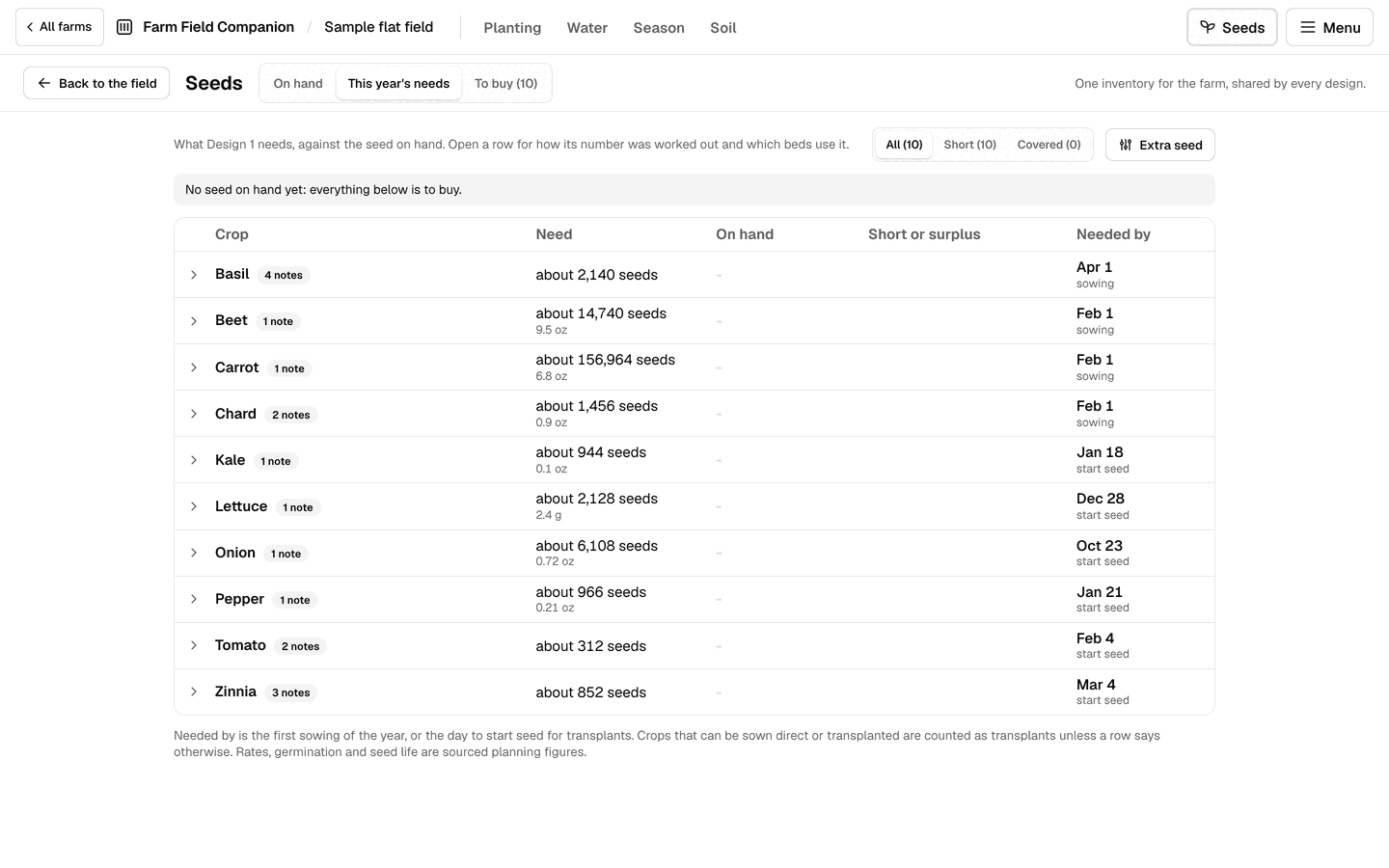
- This year’s needs: the seed every crop in the plan needs, matched against what you have, with the date it is needed by (the day to start transplants, or the first sowing date for crops sown direct). “Show me where” points out the beds that need it.
- To buy: what is short, ready to download as a CSV for your seed order. When the order arrives, it goes into On hand.
The need follows the plan. Add a succession in Season mode or widen a bed, and the figures change with it. For a crop that can go either way, one switch says whether you sow it direct or transplant it, since the two need very different amounts of seed. When you choose a crop for a row, the picker marks the ones you already have on hand.
Honest about units
Seed is counted in whatever unit you have it in, and the planner converts only where it has a sourced figure. A need in seeds against a lot in grams, for a crop with no sourced seeds per gram, reads “cannot compare units” rather than a made up number. Seeding rates and germination standards are typical planning values; your own germination test, when you enter one, is used instead.
What it does not do
It does not place orders or know supplier prices. Hedgerow plants and seed mixes are counted but carry no needed by date. Figures are planning estimates, so round up for the crops you cannot do without.
Questions
- How much seed do I need?
- Where a crop has a sourced seeding rate, a direct sowing needs its row length times that rate. Otherwise it is the plants in the plan divided by the germination rate, raised by a margin for losses (30 percent for transplants and 20 percent for direct sowings by default, both editable). Each figure shows how it was reached.
- Can I count seed in packets?
- Yes, if you give the number of seeds in a packet. Without it, the planner says it cannot count that lot rather than guessing a packet size.
- Is the seed list per design or per farm?
- Per farm. Seed on hand belongs to the farm, so it stays put when you start a new design or a new year.
See also
- Garden bed planner: Draw beds, paths and structures on your own outline to scale, and see how many plants fit in every row.
- Succession planting planner: Sowing dates, successions and harvest by the week for every bed, on one timeline.
- All features, and pricing: one subscription for every flat field you own.